Tradition Technique and Transformation: Taiwan’s Contemporary Legend Theatre in Performance

Tradition, Technique & Transformation: Taiwan’s Contemporary Legend Theatre in Performance

Friday, January 16th, 2026

3:00 PM – 5 PM ET

In-person Event

University Student Center (USC) Room 309

800 21st Street Northwest

Washington, DC 20052

Join us for an electrifying exploration of classical Chinese theatre through the artistry of three master performers in the GWU’s USC RM 309

Join us for an electrifying exploration of classical Chinese theatre through the artistry of three master performers from Taiwan’s renowned Contemporary Legend Theatre: Howie Po-Cheng Chu (wusheng/martial combatant), Yi Yuan Lin (hualian/painted-face warrior), and Wei Chuan Chang (wuchou/comic).

In this immersive performance and workshop, these internationally acclaimed artists will demonstrate the technical sophistication, physical precision, and cultural significance of classical Chinese opera performance—from acrobatic combat sequences and intricate facial painting conventions to comedic timing rooted in centuries of theatrical tradition. Participants will have the opportunity to learn foundational movement techniques and gain insight into how Contemporary Legend Theatre’s innovative approaches to classical forms have earned recognition worldwide.

Whether you’re interested in performance studies, martial arts, visual culture, Asian theatre, or simply experiencing one of the world’s most captivating performance traditions, this event offers an accessible yet rigorous introduction to a living classical art form. All are welcome—no prior experience necessary.

About the Performers

Howie Po-Cheng Chu is the troupe leader of Contemporary Legend Youth Theatre. He is currently pursuing a master’s degree in cross disciplinary performance arts at the National Taiwan University of the Arts. Specializing in laosheng (mature male roles) and wusheng (martial male roles) in Chinese theatre, Chu was a direct disciple o Wu Hsing-Kuo, the founder of Contemporary Legend Theatre, for seven years before formally becoming his student at age 26. In 2023, he received the Golden Melody Award for Best Young Performer in the Theatre/Opera category, and in 2025, he was recognized as an Asian Cultural Council award recipient. His performance credits include A Midsummer Night’s Dream, Faust, Water Margin 108, an The Woman of Loulan.

Yiyuan Lin specializes in the chou (clown) role, with particular expertise in martial chou performance (wu chou). In 2019, he formally became a disciple of Shi Xiaoliang, first-class chou role master with the Tianjin Youth Beijin Opera Troupe. His repertoire includes: Qibu Wenttan Shiqian Dao Jia, Da Gua Yuan, San Cha Kou, Dao Yin Hu, Dang Ma, Jie Shan, Nao Long Gong, among others. Performance credits include: Taiwan tour of Water Margi 108 (2018-2019), Edinburgh Fringe Festival and Avigno Off Festival production of Hero Wu Song (2018-2019) Sibiu Arts Festival production of Faust, Shanghai production of Waiting for Godot, and other domestic and international performances.

Ben Levine in professional attire

Weiquan Zhang specializes in the jing (painted-face) role an is a graduate of the National Taiwan College of Performing Arts. His extensive repertoire includes both classical pieces and experimental works. He won first place in the youth division of the Meng Xiaodong Beijing Opera Competition in 2022. His performance credits include starring roles in Contemporary Legend Theatre’s productions such as Water Margin 108: Tale of Quelling the Bandits, The Woman of Loulan, The Quee Mother of the West, and Caesar, as well as immersive theatre productions and the Legendary Theatre: Art Decides Heaven series.
logo of the Taiwan Education and Research Program

04/03/2025 | From Traditional Chinese Opera to the World Stage: The East-West Cultural Collision of Contemporary Legend Theatre

From Traditional Chinese Opera to the World Stage: The East-West Cultural Collision of Contemporary Legend Theatre

Thursday, April 3rd, 2025

3:30 – 5:30 PM ET

Room 113

Elliott School of International Affairs

1957 E Street NW Washington, D.C. 20052

The GW Taiwan Education and Research Program (TERP) cordially invites you to its upcoming Taiwan Humanities Lecture on the topic of Peking opera culture and historical anecdotes in Taiwan!

Join us for a unique event and performance demonstration with theatre actor and artistic director Chu Po-Cheng, recipient of a 2024 Asian Cultural Council grant to research and study the diverse and free-form expressions of Broadway theater (both on and off-Broadway). He will speak about the importance of Wu Hsing-kuo, a Taiwanese born actor, playwright, director, and Fulbright Scholar known around the world for his adaptations of Western theatre into traditional Peking Opera. After introducing the works of Wu Hsing-kuo, Chu will highlight several performances and pieces of the Contemporary Legend Theatre (CLT), a Taiwanese performing arts company that was created in 1986 by Wu Hsing-kuo, and became renowned worldwide for integrating traditional Peking Opera techniques with Western classical plays. Po-Cheng will then introduce Peking opera, its origins and global spread. He will then conclude by performing Lin Chong’s Night Flight, a classic traditional Peking Opera piece, and answering questions from the audience.

Chu Po-Cheng is a Contemporary Legend Theatre actor, and artistic director of Hsing Legend Youth Theatre. Specializing in martial artist and elderly male roles, he is a disciple of the international master Wu Hsing-kuo. Currently pursuing a Master’s degree in Interdisciplinary Performing Arts at the National Taiwan University of Arts.

Venturing across Peking Opera, modern dance, and contemporary theater, he is a new-generation multi-disciplinary performing artist in Taiwan. Chu won the Best Young Actor Award at the 34th Taiwan Traditional Arts Golden Melody Awards in 2023 and received the Asian Cultural Council Fellowship in 2024. In 2016, he won second place in the Elderly Male category at the Meng Xiaodong Peking Opera Art Scholarship Foundation competition.

Works as a writer, director, and actor: ” Wu Song” (2018) was performed at the Edinburgh Festival Fringe in the UK, receiving a four-star review, and was selected by the Taiwanese Ministry of Culture to perform at the Festival d’Avignon in France in 2019.

In 2020, “The Youth Party” was selected by the Taiwanese Ministry of Culture to perform at the Festival d’Avignon in France. In 2021, he was commissioned by the Taoyuan Iron Rose Arts Festival to produce “2221-Eternal Flower.”

The Taiwan Education and Research Program was established in 2004 to promote and support both academic and policy-related study and research on the history, international relations, and the contemporary political, economic and social development of Taiwan. The Taiwan Education and Research Program operates under the Sigur Center for Asian Studies at The George Washington University’s Elliott School of International Affairs. The program is co-directed by Alexa Alice Joubin, Professor of English, Women’s Gender and Sexuality Studies, Theatre, International Affairs, and East Asian Languages and Literatures, and Richard Haddock, Assistant Director, Sigur Center for Asian Studies.

logo of the Taiwan Education and Research Program

Empowering Teachers to Empower Learners: Exploring AI Tools for Teaching Chinese

Saturday, July 27th, 2024

7:30 PM – 10:30 PM ET

Virtual Event via Zoom

About the event: 

This workshop will guide teachers step-by-step in using large language models (LLM) to generate Chinese teaching materials. It will utilize backward design to create innovative teaching strategies and lesson plans, and discuss how to use user-friendly generative AI tools to facilitate students’ autonomous Chinese learning. We will focus on the following areas:

-Fundamental principles and application examples of generative AI tools.
-How to design and generate Chinese teaching materials suitable for different language proficiency levels.
-Specific applications and case studies of the backward design method in teaching.
-Strategies to enhance students’ autonomous learning abilities through generative AI tools.
-Hands-on practice sessions allowing participants to experience the practical application of AI tools.

Speaker:

Yujen Lien (連育仁 Lian Yuren) is currently the Dean of ViewSonic Academy and an Associate Professor in the Department of Applied Chinese Language and Literature at Chung Yuan Christian University (中原大學). He has previously served as an Associate Professor and Director of the Chinese Language Teaching Center at the same university. Due to his work experience, educational background, and interests, Professor Lian is highly familiar with teaching tools, online services, and hardware and software related to the integration of digital technology into international Chinese education. Since 2007, he has lectured on digital Chinese teaching techniques and strategies in over 40 countries and has his own teaching channel and community on the internet. His digital teaching training channel has over 50,000 subscribers, with total views exceeding 6.5 million. These educators continue to discuss and actively integrate emerging technologies into both physical and online classrooms. (YouTube Channel: https://www.youtube.com/@lienlaoshi)

The Sigur Center for Asian Studies and GW Institute for Korean Studies (GWIKS) together received the highly regarded designation of National Resource Center (NRC) for East Asian Studies. The designation — the first time these two centers have received NRC status — enhances the institutes’ ability to engage the broader public community, including students, K-12 educators, HBCUs, policymakers, military veterans, journalists and the general public on regional and global issues of importance. With this award, GW joins a handful of other world-leading universities with this honor, including Stanford, Columbia, and the University of Chicago. Additionally, the Sigur Center and GWIKS have been awarded funding for Foreign Language and Area Studies (FLAS) Fellowships which support undergraduate and graduate students studying modern foreign languages and related area or international studies.

The Department of East Asian Languages and Literatures (EALL) focuses on teaching and research on the languages and cultures of China, Japan and Korea. We offer undergraduate majors and minors in all three language tracks, as well as a unique master’s program in Chinese. Our internationally published faculty are experts in the languages, culture and literature of East Asian peoples, from ancient civilizations to modern times. In today’s global economy, knowledge of East Asia can provide a crucial stepping stone to careers in academia, business, diplomacy, government, medicine, law and much more.

The Taiwan Education and Research Program was established in 2004 to promote and support both academic and policy-related study and research on the history, international relations, and the contemporary political, economic and social development of Taiwan. The Taiwan Education and Research Program operates under the Sigur Center for Asian Studies at The George Washington University’s Elliott School of International Affairs. The program is directed by Liana Chen, Associate Professor of Chinese Language & Literature, and Alexa Alice Joubin, Professor of English, Women’s Gender and Sexuality Studies, Theatre, International Affairs, and East Asian Languages and Literatures.

logo of the Taiwan Education and Research Program

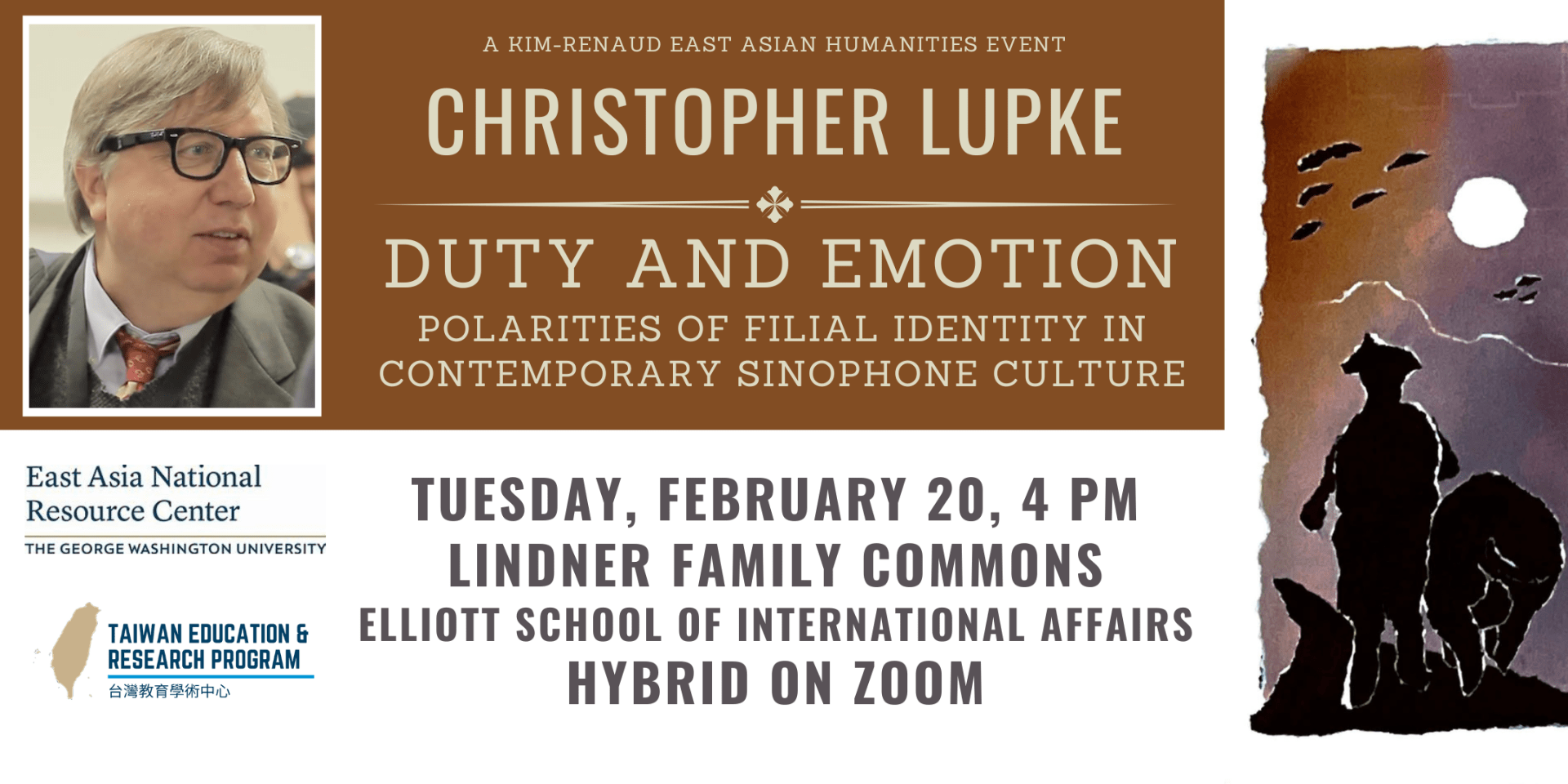
02/20/2024 | Duty and Emotion Polarities of Filial Identity in Contemporary Sinophone Culture

Duty and Emotion
Polarities of Filial Identity in Contemporary Sinophone Culture

Tuesday, February 20, 2024

4:00 PM – 5:30 PM ET

Lindner Family Commons Room 602

Elliott School of International Affairs

1957 E Street NW Washington, D.C. 20052

One of the great themes of modern Chinese and Sinophone culture is the emergence of new forms of individual identity that break free of the confines of what May Fourth intellectuals such as Lu Xun, Wu Yu, Chen Duxiu, Ba Jin, and others have imputed to filiality 孝, one of the cornerstones of traditional Chinese thought, ethics, and subject-formation. But filiality has not retired from the scene of intellectual discourse as quickly and easily as some had thought it would. The modern era is in one sense a battle between the time-honored obeisance to one’s elders on the one hand and individualism on the other. This Manichean conflict presumes that we think of filiality in terms of duty: devotion to one’s parents and ancestors; heterosexual bonding and marriage; the production of biological heirs, especially sons; and honorable deeds that bring pride to parents and family.

Deeply engrained in Chinese society since pre-Confucian times, and codified by Confucius, Mencius, and their followers, the filial structure of selfhood and conduct is virtually synonymous with the fundamental essence of Chinese culture in its purest form. This is only true if we conceive of filiality as a prescribed protocol for upright behavior. But what about the feelings associated with filiality? In a recent book that promises to redraft our perspective on filiality, Maram Epstein seeks to place affect, or the emotional component of human existence, at the forefront of our understanding of the nature of filiality, suggesting that the modern repudiation of filiality has tainted our entire thought-structure as to what filiality means historically and how it functions.

Epstein’s work on Ming and Qing China has prompted Professor Lupke to reflect on his own understanding of filiality, asking how it fosters emotional bonds such as affiliations to one’s parents in positive ways. In this presentation, Professor Lupke will use his refreshed attention on affect to explore the emotional terrain of filial relationships in contemporary Sinophone works. He will examine works by Huang Chunming, Bai Xianyong, Wang Wenxing, Hou Hsiao-hsien, and the contemporary US-based poet Zhang Er. At issue is the crucial role that overwrought emotions play in the filial dynamic in intergenerational relations that we see so much of in the Sinosphere and in Sinophone cultural production.

The event is open to the public. Guests who register for the event will receive details for joining the Zoom meeting.

About

Speakers

Christopher Lupke (Ph.D. Cornell University) is Professor of Chinese Cultural Studies at the University of Alberta. A scholar of modern and contemporary Chinese literature and cinema, he is the author of The Sinophone Cinema of Hou Hsiao-hsien: Culture, Style, Voice, and Motion (Cambria Press; 2016). He has written, edited, co-edited, or translated seven books including The Magnitude of Ming, New Perspectives on Contemporary Chinese Poetry, Chinese Poetic Modernisms, Dictionary of Literary Biography: Chinese Poets since 1949, and the multi-volume reference work Wiley-Blackwell Companion to World Literature. He also has edited or co-edited five special journal issues. Lupke’s translation of Ye Shitao’s monumental A History of Taiwan Literature was awarded the Aldo and Jeanne Scaglione Award from the MLA and his career- long dedication has won him the Michael Delahoyde Award for Distinguished Editing from the Rocky Mountain MLA. Lupke’s current research focuses on the Confucian notion of “filiality” in contemporary Chinese culture, a bedrock philosophical notion and popular value that dates to before the times of Confucius in China and maintains its relevance in Chinese society today.

East Asian National Resource Center Logo